6 min read
Back to Blog
Port State Control isn't messing around either. PSC deficiencies jumped from 197 cases in 2020 to 523 deficiencies and 12 detentions in 2024. That's a 266% increase. Inspectors are looking harder, and they're finding plenty.
Need Help with SMS Compliance?
---
Maritime Safety
Pilot Ladder Safety - Why the UKMPA's New Interactive Guide Matters
J. Fulton
Marine Pilot & Founder of SeaReady
Pilot Ladder Safety: Why the UKMPA's New Interactive Guide Matters
Published by J. Fulton | 6 min read
Pilot Ladder Incidents Are Still Too Common - But They're Preventable
I've stood on the deck of a pilot boat, looking up at a badly rigged pilot ladder, weighing whether it's safe enough to climb. That moment of uncertainty shouldn't exist in 2025. But it does.
In 2022, UK ports saw over 400 pilot ladder incidents from 96,000 transfers. The Marine Accident Investigation Branch estimates that's only half the real number. One pilot fell 3 meters onto a pilot boat and fractured his ankle. He was lucky — others haven't been.
Here's the sobering reality: half of all pilot ladder incidents come down to bad rigging. Shackles instead of rolling hitches. Worn-out ladders nobody bothered replacing. Handhold stanchions that fail when you need them most. These aren't freak accidents—they're preventable failures.
That's why the UKMPA's new Interactive Pilot Ladder Guide matters. It's not another poster to file away. It's a practical tool that makes compliance easier—but only if the industry actually gives a damn.
What's New and Why You Should Care
The UKMPA guide launched in August 2025 as part of something bigger: the most significant changes to pilot ladder regulations in decades.
SOLAS Regulation V/23 was completely rewritten in June 2025, and the new rules have teeth. The big one? The 30-36 month replacement rule. Your pilot ladder must be replaced 30 months after entering service or 36 months after manufacture—whichever comes first. Doesn't matter if it looks perfect. Doesn't matter if you've barely used it. If it's past the date, it's scrap.
That's not the only change. You now need spare ladders and manropes onboard. Mechanical hoists are banned outright. And if a single step is damaged, you can't just swap it out anymore—the entire ladder gets condemned. No repairs, no shortcuts.
The deadlines are tight:
- January 2028 – New equipment must comply
- January 2029 – Existing SOLAS ships must comply at first survey
- January 2030 – Non-SOLAS ships must comply
Port State Control isn't messing around either. PSC deficiencies jumped from 197 cases in 2020 to 523 deficiencies and 12 detentions in 2024. That's a 266% increase. Inspectors are looking harder, and they're finding plenty.
The UKMPA guide helps you understand what compliance actually looks like before an inspector shows up with a deficiency notice.
The Real Problem: Culture, Not Compliance
The maritime industry has treated pilot ladder safety like a compliance box to tick. Fill out the paperwork, pass the audit, move on. But 16% non-compliance rates tell a different story—voluntary compliance isn't working.
Kevin Vallance, one of the guide's developers, co-founded the #dangerousladders campaign on social media to document unsafe ladder configurations worldwide. The campaign has shown thousands of examples of non-compliance, and the pattern is clear: operators aren't failing because the rules are unclear. They're failing because they're not prioritizing it.
The new SOLAS amendments exist because the old approach failed. Too many near-misses. Too many injuries. Too many deaths. The IMO got the message: stronger rules, clearer standards, and real enforcement were essential.
This isn't about paperwork anymore. It's about whether you're willing to put a pilot's life at risk to save a few hundred quid on a replacement ladder.
What You Actually Need to Do
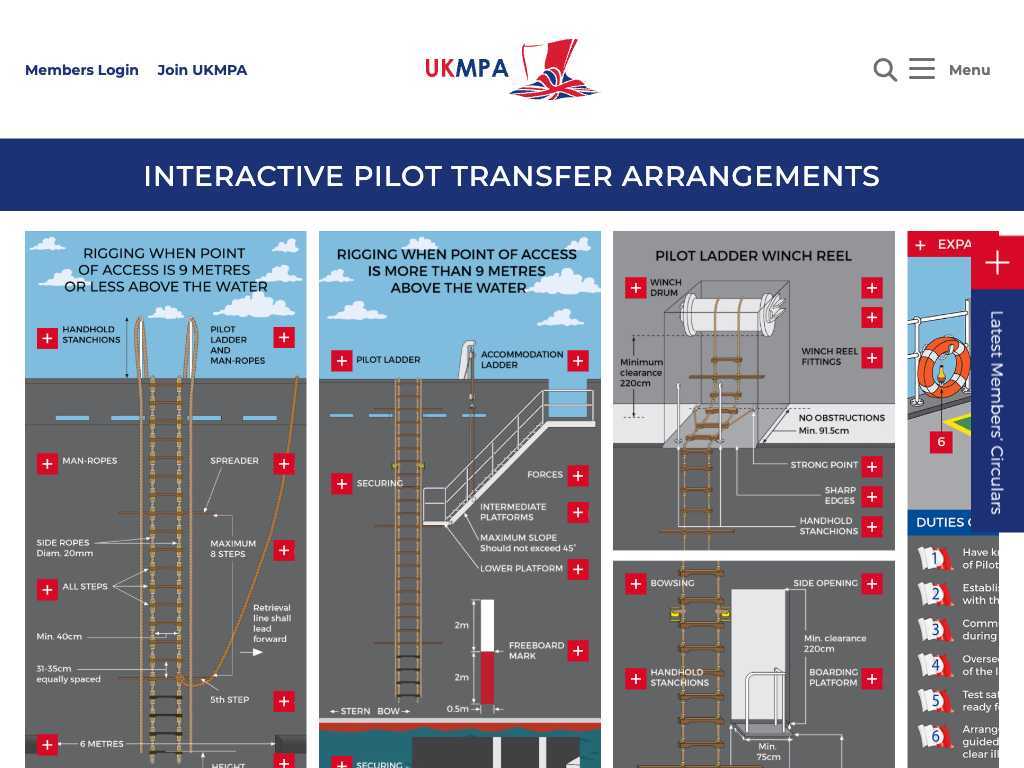
The UKMPA Interactive Guide is free and accessible on any device. It shows you side-by-side comparisons of compliant and non-compliant setups, with clickable diagrams that explain exactly what's wrong. Use it. Here's what else you need to do:
1. Audit Your Equipment Now
Check every pilot ladder and manrope onboard. Look at the certification plate and find the manufacture date and the date it entered service. Do the math. If it's approaching the 30-36 month limit, schedule a replacement before January 2028. If it's damaged—frayed ropes, cracked steps, worn spreaders—condemn it today.
2. Build the Replacement Cost Into Your Budget
This is no longer a one-time purchase. Pilot ladders are now a recurring operational expense, just like fuel or insurance. Factor in lead times for ordering from approved manufacturers. If you wait until 2027, you'll be competing with every other operator scrambling to meet the deadline.
3. Train Your Crew with the Interactive Guide
Integrate the guide into your safety meetings and officer familiarization. Walk through the scenarios. Test crew knowledge. Make sure everyone understands what correct rigging looks like—not what they think looks "good enough."
4. Update Your Safety Management System
If you're operating under ISM Code, WBC3, or any SMS framework, your pilot transfer procedures need updating. Document your inspection schedules, maintenance records, training sessions, and replacement plans. PSC inspectors will ask for this, and "we'll get to it" won't cut it.
If you're still using paper systems, now's the time to move to something digital that won't let equipment slip through the cracks. Contact SeaReady to see how a digital SMS can help manage your pilot transfer compliance.
This Isn't About Regulations—It's About People
Every pilot boarding your vessel is someone's colleague. Someone's family member. They're doing essential work to keep ships safe in pilotage waters, and they deserve a ladder that won't kill them.
The UKMPA Interactive Guide makes compliance easier. The new SOLAS amendments make the rules clearer. The #dangerousladders campaign is holding operators accountable. The enforcement is ramping up.
But none of that matters if you treat this like a bureaucratic hurdle instead of a life-safety issue.
The question isn't whether you can comply. It's whether you will.
Your Next Steps
- Access the guide: UKMPA Interactive Pilot Transfer Arrangements
- Audit your equipment: Check manufacture dates and service dates against the 30-36 month rule
- Train your crew: Use the interactive guide in safety meetings and familiarization
- Update your SMS: Document your inspection, maintenance, and replacement plans
---
Additional Resources
Official Guidance:
- UKMPA Interactive Pilot Transfer Arrangements
- MCA MSN 1716 (M+F) – Pilot Ladders
- The Pilot Ladder Manual (2nd Edition, 2024) by Kevin Vallance – Witherbys Publishing
Need Help with SMS Compliance?
- SeaReady SMS – Digital safety management and compliance tracking
- Book a Demo – See how we can help manage your maritime compliance
---
J. Fulton is a Marine Pilot and founder of SeaReady, providing digital safety management solutions for maritime operators. As a practicing pilot, J. Fulton has first-hand experience with pilot transfer arrangements and is committed to improving maritime safety through practical, technology-driven compliance tools.
Pilot LaddersSOLASMaritime SafetyCompliancePort State ControlUKMPA
About the Author
J. Fulton
Marine Pilot & Founder of SeaReady
The SeaReady team develops maritime software solutions built by mariners, for mariners. Combining decades of seagoing experience with modern technology, we create practical tools that solve real operational challenges in the maritime industry.
Related Articles
Port Innovation26 Jan 2025
From Paper to Precision - Why Electronic Master Pilot Exchange is the New Standard
Electronic Master Pilot Exchange (eMPX) systems transform the critical vessel handover from static paper processes to dynamic, verified data exchange - eliminating bridge distractions, ensuring data integrity, and enhancing situational awareness through PMIS integration and automated UKC calculations.
Maritime Insights26 Jan 2025
Navigating Workboat Code 3: Your Essential Guide to Mandatory SMS
As of December 2023, WBC3 is now law. The most significant change? Your Safety Management System is now mandatory, with a firm deadline of December 2026 for implementation.